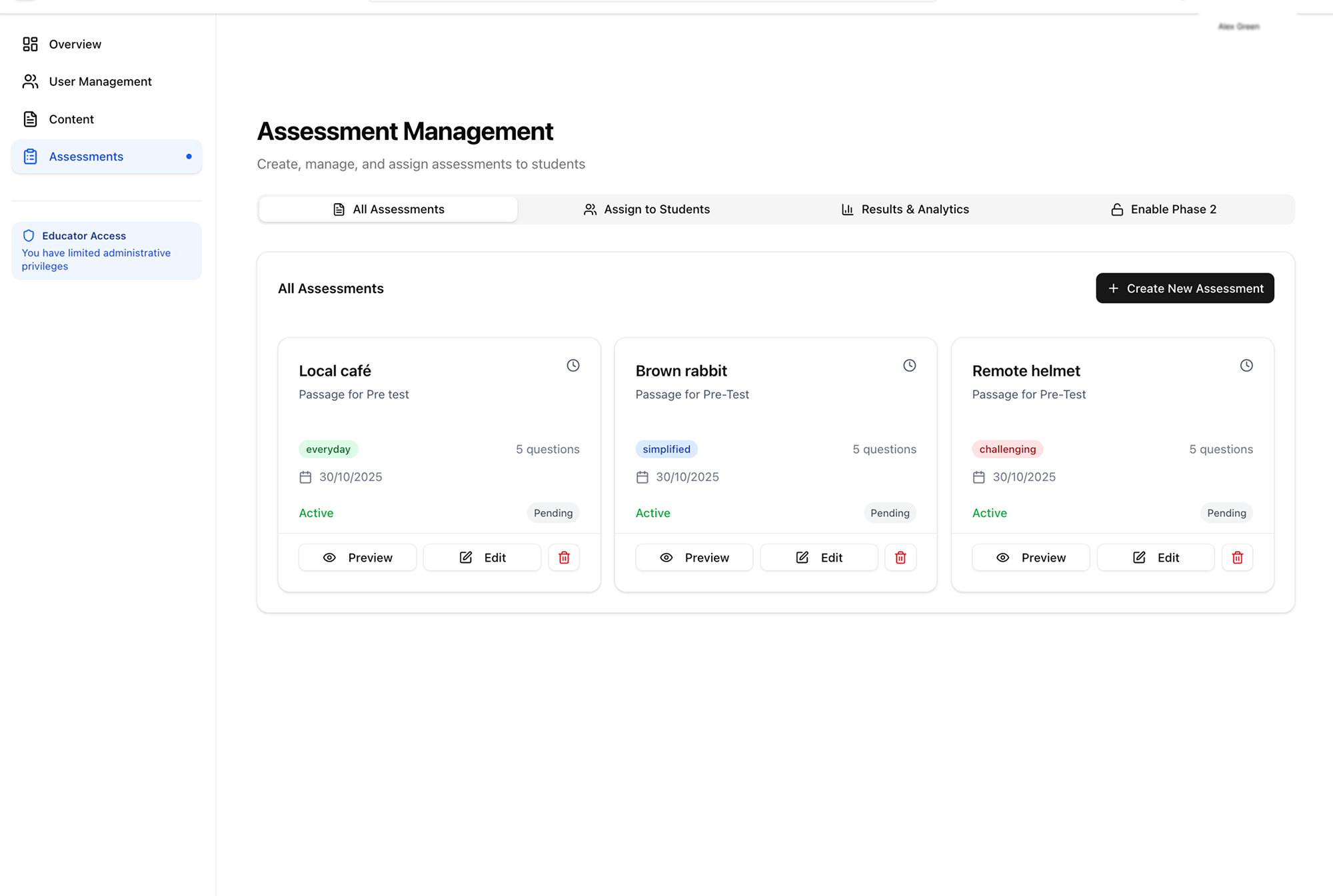
The challenge was to move beyond static assistive technology and build a dynamic "Research-to-Production" platform. In partnership with Swinburne University, the goal was to create a dual-phase testing environment that could scientifically measure the impact of assistive tools on learning outcomes. We engineered a system that doesn't just display text; it reconstructs it. Utilizing a Next.js 15.5 and GPT-4 Turbo stack, the platform processes complex educational documents (PDF/DOCX) into 20 distinct cognitive aids—including mind maps, simplified summaries, and focus segments—cached permanently for near-zero latency and high cost-scalability.
Key Strategic Pillars
The AI Processing Engine
Instead of a simple chatbot interface, we built a "Process-Once, Cache-Forever" workflow. Every piece of content uploaded by an educator is instantly atomized into: Visual Transformations: OpenDyslexic typography and custom chromatic overlays. Cognitive Scaffolding: Automated mind maps, flashcards, and 150-word "Focus Summaries." Zero-Cost Accessibility: Browser-native Web Speech API integration for word-by-word highlighted Text-to-Speech. Data-Driven Insights
The platform features a sophisticated analytics dashboard for researchers and administrators. By utilizing Supabase with 55+ migration tables, we track real-time engagement and comparative performance between Phase 1 (Baseline) and Phase 2 (Assisted) testing environments, providing the empirical data needed to drive institutional change. Technical Footprint (The Studio Advantage)
To ensure the platform was both "Investment-Ready" and "Production-Stable," we deployed an elite tech stack: Frontend Velocity: Next.js 15.5 with React 19 for unmatched rendering speed. Secure Infrastructure: 29 Supabase Edge Functions with Row Level Security (RLS) and AES-256 encryption. Optimized Scalability: A monthly operational cost of ~$140 for 1,000 students, ensuring a 95%+ profit margin for institutional licensing.