Engineered for Impact

A showcase of custom platforms, AI agents, and digital products built to solve complex business problems.
Don't just look at the design. Look at the speed, logic, and results.
Scroll
LexiaFlow
LexiaFlow
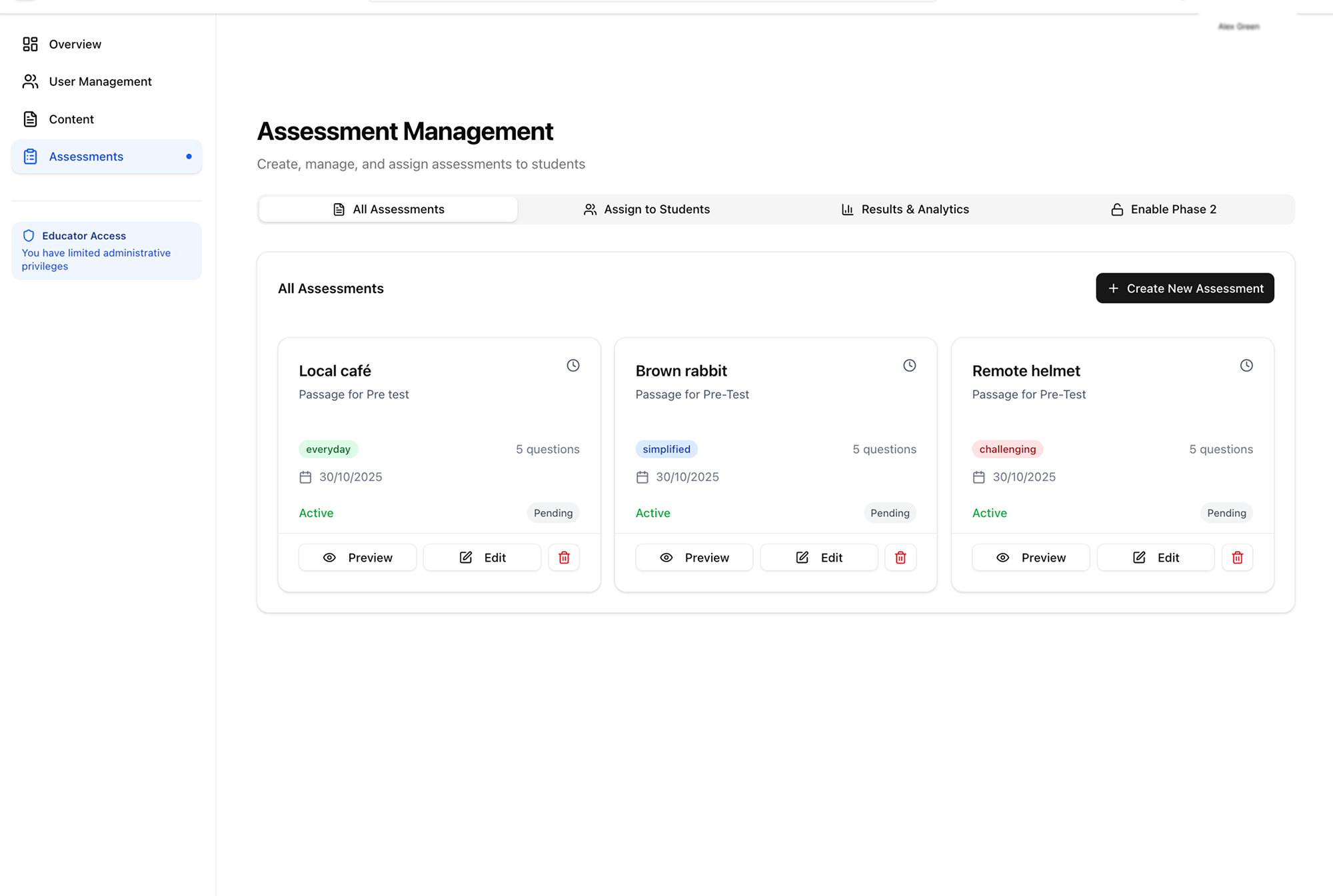
The challenge was to move beyond static assistive technology and build a dynamic "Research-to-Production" platform. In partnership with Swinburne University, the goal was to create a dual-phase testing environment that could scientifically measure the impact of assistive tools on learning outcomes. We engineered a system that doesn't just display text; it reconstructs it. Utilizing a Next.js 15.5 and GPT-4 Turbo stack, the platform processes complex educational documents (PDF/DOCX) into 20 distinct cognitive aids—including mind maps, simplified summaries, and focus segments—cached permanently for near-zero latency and high cost-scalability. Key Strategic Pillars The AI Processing Engine Instead of a simple chatbot interface, we built a "Process-Once, Cache-Forever" workflow. Every piece of content uploaded by an educator is instantly atomized into: Visual Transformations: OpenDyslexic typography and custom chromatic overlays. Cognitive Scaffolding: Automated mind maps, flashcards, and 150-word "Focus Summaries." Zero-Cost Accessibility: Browser-native Web Speech API integration for word-by-word highlighted Text-to-Speech. Data-Driven Insights The platform features a sophisticated analytics dashboard for researchers and administrators. By utilizing Supabase with 55+ migration tables, we track real-time engagement and comparative performance between Phase 1 (Baseline) and Phase 2 (Assisted) testing environments, providing the empirical data needed to drive institutional change. Technical Footprint (The Studio Advantage) To ensure the platform was both "Investment-Ready" and "Production-Stable," we deployed an elite tech stack: Frontend Velocity: Next.js 15.5 with React 19 for unmatched rendering speed. Secure Infrastructure: 29 Supabase Edge Functions with Row Level Security (RLS) and AES-256 encryption. Optimized Scalability: A monthly operational cost of ~$140 for 1,000 students, ensuring a 95%+ profit margin for institutional licensing.
VIEW DETAILS
Web App
Website

All Projects

LexiaFlow
LexiaFlow
The challenge was to move beyond static assistive technology and build a dynamic "Research-to-Production" platform. In partnership with Swinburne University, the goal was to create a dual-phase testing environment that could scientifically measure the impact of assistive tools on learning outcomes. We engineered a system that doesn't just display text; it reconstructs it. Utilizing a Next.js 15.5 and GPT-4 Turbo stack, the platform processes complex educational documents (PDF/DOCX) into 20 distinct cognitive aids—including mind maps, simplified summaries, and focus segments—cached permanently for near-zero latency and high cost-scalability. Key Strategic Pillars The AI Processing Engine Instead of a simple chatbot interface, we built a "Process-Once, Cache-Forever" workflow. Every piece of content uploaded by an educator is instantly atomized into: Visual Transformations: OpenDyslexic typography and custom chromatic overlays. Cognitive Scaffolding: Automated mind maps, flashcards, and 150-word "Focus Summaries." Zero-Cost Accessibility: Browser-native Web Speech API integration for word-by-word highlighted Text-to-Speech. Data-Driven Insights The platform features a sophisticated analytics dashboard for researchers and administrators. By utilizing Supabase with 55+ migration tables, we track real-time engagement and comparative performance between Phase 1 (Baseline) and Phase 2 (Assisted) testing environments, providing the empirical data needed to drive institutional change. Technical Footprint (The Studio Advantage) To ensure the platform was both "Investment-Ready" and "Production-Stable," we deployed an elite tech stack: Frontend Velocity: Next.js 15.5 with React 19 for unmatched rendering speed. Secure Infrastructure: 29 Supabase Edge Functions with Row Level Security (RLS) and AES-256 encryption. Optimized Scalability: A monthly operational cost of ~$140 for 1,000 students, ensuring a 95%+ profit margin for institutional licensing.
Web App
Website